Friday, April 29, 2011

Architecture Rough Draft


During and in the times after the Roman empire, there were many changes in the way buildings, especially of religious significance, were built. These buildings were made to display the kinds of things the people in these eras believed in. The Romanesque culture was focused more on sacrificing and preparing for judgment day. They knew that there would be another time when the Lord would return, and they stressed that one had to be ready on his/her own day of judgment. On the other hand, people in the Gothic era were more focused on the goodness of the Lord and how he was a sort of light in one's life.  The evidence of religion in the architecture of both the Romanesque and Gothic periods is very clear, and shown in many aspects of the structures such as size, lighting, images, and windows.


The images on the fronts of the buildings were a big indication as to what sort of belief was being celebrated during the time the building was made. As shown below in figure 1 on the Schöngrabern in lower Austria, the images seen on the fronts of the buildings in Romanesque times featured scenes of sacrifice to God and things that would make him happy, to show that the people were worthy to be accepted into the kingdom of heaven. Meanwhile, as seen on the front of St. John's Cathedral in old Lyon, France, the fronts of buildings in the Gothic era were often of saints together, or formations that look like beautiful flowers and pieces of nature. This sort of image portrays the true happiness one would experience with God, which was the general idea of religion in that time period. The designs on the front of the churches are especially visual, and really display the biggest values of the religious community during that era very well.

Another interesting aspect of the architecture that really brings out the religious aspects of the people were the windows in these buildings. In Romanesque times, (figure 3,  St. Gertrude Collegiate church in Belgium) there were few to no windows inside the buildings. The windows that did appear were very thick in the walls around them. This was a display of the sort of seriousness the Romans had about religion. Because their major concern in religion was preparation for judgment day, they didn't focus on decorations and fancy things within the windows. The buildings were often plain and single-toned, to show the strength of the church. On the other hand, Gothic churches such as  Pöide church in Estonia (figure 4) had colorful stained-glass windows that displayed images of the saints and angels. This added beauty and feeling into the church, again showing the beautification of what it meant to follow God.

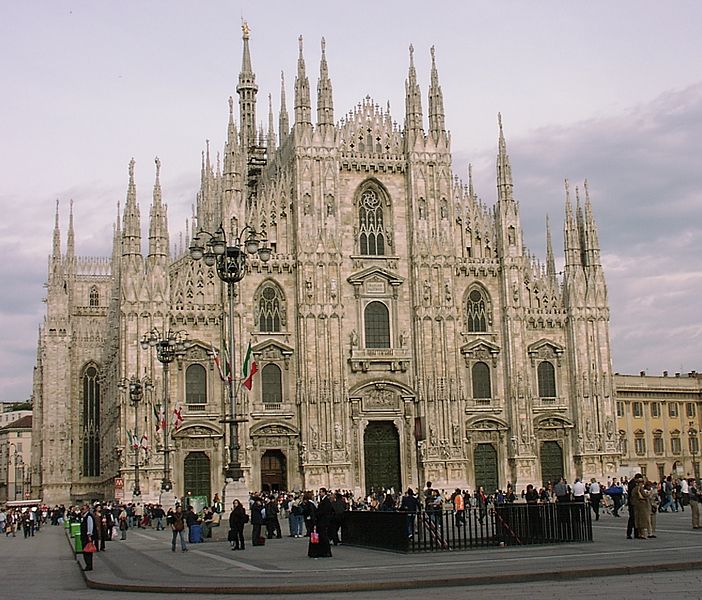
Possibly the most obvious piece of evidence is the total exterior form of the buildings. During the Romanesque times, as seen if you look at St. Gertrude Collegiate in Belgium (figure 5) the buildings don't look as elegant as the ones  during the Gothic times, like the front of the Milan cathedral in France. (figure 6) This is because the buildings in Romanesque times were made to look more like protecting fortresses, and the Gothic structures looked more like castles. This was a way of displaying grace and beauty in the religious life, while the Romans were, again, focused more on protection (the purpose of a fortress) and preparation, for when the Lord comes to judge them again. As someone even comes to approach the building, they would know weather the focus of this group of people was protection or beautification.


The Gothic and Romanesque periods were two completely different times in many aspects, architecture being one of the most obvious. Through their designs and alterations, you can see the values of people displayed in those buildings. From the thickness of the walls and windows to the pictures on the front entrance, meaning and belief are displayed everywhere in these structures.


Figure 1


Figure 2


Figure 3


Figure 4

Figure 5


Figure 6


Links: 


Thursday, April 7, 2011

Stoicism

When man is faced with difficult and stressing situations, things tend to go wrong due to distraction from emotional needs. It's hard to go through with the task at hand when horrible things are happening to the ones you love. Around the year 300 B.C., a philosophical belief cropped up among human society, that was formed to do away with these emotional distractions and commitments. This belief was demonstrated by many great leaders at times of great danger and stress, and is referred to as stoicism.  Stoicism is a belief that when one is confronted with hardships one must control his emotions; the events surrounding the death of Seneca are a perfect example of stoicism in action. There are may other written examples of Stoicism in history, and the death of Seneca is not necessarily the best example of that philosophy.

Seneca, a stoic philosopher and advisor to the Roman emperor Niro, had learned one night that he was going to be put to death by the very man he had been guiding and teaching for years before. The night Seneca had been told he was to be killed, his wife told him that she was going to die with him. However, during his execution, Seneca became worried for her sake. “Worn out by cruel anguish, afraid too that his sufferings might break his wife's spirit, and that, as he looked on her tortures, he might himself sink into irresolution, he persuaded her to retire into another chamber.” (Tacitus, 65 CE). Even during his own torturous death, Seneca was still worried for the well-being of those around him, as he wanted to be sure that his wife would not become upset, hearing him struggle. The philosophy of stoicism is that you must put your own emotions aside, to deal with the other situations at hand. Sometimes, this can mean the emotional well-being of those around you. At this time, Seneca was being tortured to death with knives, but the only thing he was worried about was his own wife's well-being. The extreme pain and struggle that he was under was pushed so far to the side that if it weren't for the constant physical reminder of the situation at hand, it might have been possible that Seneca would have forgotten what was happening to him altogether.

Some may look at the piece of evidence above and say that that could just be a demonstration of pure love and devotion to one's spouse. However, it is clear that by the later years of his life, anything, including the legal matters of those around him, seemed to matter more than his own emotions. "...even at the height of his wealth and power, he had been thinking about his life's close…" (Tacitus, 65 CE) Another clear characteristic of a stoic is that he is always looking towards what is happening next, so he can be better prepared. Seneca's wishes for his burial had been written many years before there was even a hint if discomfort between him and Niro, that he might even consider killing such a faithful advisor to him. In order to distract himself from showing any inkling of emotion in a time of great happiness, Seneca chose instead to plan for the future, in case the situation he found himself in ever became bleak or uncertain. Everything Seneca seemed to do was rational beyond comparison, certainly not the typical behavior of  a man who had hit the highest point of his life.


Perhaps one of the most pressing instances of Seneca's stoic behavior occurred the night he was told he was to be put to death. “But he spared himself the anguish of a word or of a look, and merely sent in to Seneca one of his centurions, who was to announce to him his last doom. Seneca, quite unmoved, asked for tablets on which to inscribe his will..” (Tacitus, 65 CE). Right after being told he was going to die a painful and torturous death, the first thing Seneca looked towards was legal business. To him, the fact that his life was not going to last much longer didn't matter nearly as much as what was to happen  after he had been killed. He wasted no time growing upset from this news, but instead simply replied to his troubled colleagues, "'Where,' he asked again and again, 'are your maxims of philosophy, or the preparation of so many years' study against evils to come? Who knew not Nero's cruelty? After a mother's and a brother's murder, nothing remains but to add the destruction of a guardian and a tutor.'"(Tacitus, 65 CE)  Because he was so rational in his thinking, all of this made sense to Seneca. There was no shock, so there was no need for emotion. This is stoicism at its core; pure rationality.

Stoicism was incredibly relevant in the life of Seneca. Especially at the end of his existence, there were many hardships and struggles that he was forced to endure. Throughout all of the pain and torture he had to go through, Seneca made sure of one thing- that the task at hand was complete. The most important thing was not how he felt about what he had to do, but the result of what happened after it was finished. Seneca's death is one of the most relevant cases of this behavior, and is, in essence, what stoicism is all about.

Bibliography:
Tacitus: The Death of Seneca, 65 CE. (1998, May). Retrieved April 6, 2011, from Ancient History Sourcebook: http://www.fordham.edu/HALSALL/ancient/tacitus-ann15a.html

11 Point Grading System

News Flash: Starting tomorrow, April 7th, we will stop doing dailies. Instead, we will be concentrating on the weekly essays. This week's rough draft we are finishing in class. From then on, every Wednesday you will have a rough draft due for Peer review (you'll receive participation credit: P/F for having the draft ready). On your rough draft, please underline the thesis statement and in a different color prove it is an opinion by writing the opposite side; underline one quote properly cited with in-text citations for each body paragraph; make bold your four-sentence analysis of each quote; analysis should explain how the quote serves to support your thesis. After peer review, a final draft will be due on Fri by Midnight.

Eleven-Point Critique (for peer reviews and grading of final drafts)

1. 5 paragraphs -- 5 to 7 sentences per paragraph.

2 Clear, coherent thesis statement expressing an opinion to be argued in the paper.

3. One quote or piece of sourcable evidence properly cited in APA format per body paragraph / proper in-text citation format

(author, date). APA format bibliography at end of paper. Use top-notch sources (BBC, Met Museum, Nat Geo, Internet History

Sourcebook, school-library based databases, etc.)

4. Four sentences per body paragraph analysis. This is your own analysis demonstrating how the evidence supports your thesis.

5. Solid conclusion demonstrating the validity of the argument.

6. Emphasis: Put strongest evidence in the fourth paragraph.

7. No 1st or 2nd person personal pronouns (I, we, us, me, my, myself, you, etc.)

8. Academic Tone: No slang, no contractions, make it coherent and readable.

9. Avoid generalizations -- give specific information; I'm not looking for you to write an "encyclopedia" article. I'm looking for

your ability to construct an academic argument.

10. Avoid unnecessary information: "more" quotes doesn't mean a "better" paper.

11. Original and honest writing voice and a creative and remarkable take on the subject.

Wednesday, April 6, 2011

Week 6 Daily 1

 Read Tacitus' description of the Death of Seneca and Book One of M. Aurelius' Meditations. Find quotes within those two texts that help explain what Stoicism is all about.


  • “But he spared himself the anguish of a word or of a look, and merely sent in to Seneca one of his centurions, who was to announce to him his last doom.

Seneca, quite unmoved, asked for tablets on which to inscribe his will..”
This quote is a very shocking representation of Stoicism. At this moment in time, Seneca was just told that he was going to be put to death. Instead of becoming greatly upset, he simply moved onto his next order of business which was his last will and testament.

  • “Worn out by cruel anguish, afraid too that his sufferings might break his wife's spirit, and that, as he looked on her tortures, he might himself sink into irresolution, he persuaded her to retire into another chamber.”

This event was actually in the middle of Seneca’s extremely painful death, and yet he was still concerned with what was going on around him, and making sure things would still run smoothly.

  • "...even in the height of his wealth and power he was thinking of his life's close."
This quote is fairly self explanatory in that even when things were going very well, Seneca was still worried about how things would go when they went bad. Seneca was demonstrating his belief in Stoicism so that he knew things would run smoothly when he was gone.