During and in the times after the Roman empire, there were many changes in the way buildings, especially of religious significance, were built. These buildings were made to display the kinds of things the people in these eras believed in. The Romanesque culture was focused more on sacrificing and preparing for judgment day. They knew that there would be another time when the Lord would return, and they stressed that one had to be ready on his/her own day of judgment. On the other hand, people in the Gothic era were more focused on the goodness of the Lord and how he was a sort of light in one's life. The evidence of religion in the architecture of both the Romanesque and Gothic periods is very clear, and shown in many aspects of the structures such as size, lighting, images, and windows.
The images on the fronts of the buildings were a big indication as to what sort of belief was being celebrated during the time the building was made. As shown below in figure 1 on the Schöngrabern in lower Austria, the images seen on the fronts of the buildings in Romanesque times featured scenes of sacrifice to God and things that would make him happy, to show that the people were worthy to be accepted into the kingdom of heaven. Meanwhile, as seen on the front of St. John's Cathedral in old Lyon, France, the fronts of buildings in the Gothic era were often of saints together, or formations that look like beautiful flowers and pieces of nature. This sort of image portrays the true happiness one would experience with God, which was the general idea of religion in that time period. The designs on the front of the churches are especially visual, and really display the biggest values of the religious community during that era very well.
Another interesting aspect of the architecture that really brings out the religious aspects of the people were the windows in these buildings. In Romanesque times, (figure 3, St. Gertrude Collegiate church in Belgium) there were few to no windows inside the buildings. The windows that did appear were very thick in the walls around them. This was a display of the sort of seriousness the Romans had about religion. Because their major concern in religion was preparation for judgment day, they didn't focus on decorations and fancy things within the windows. The buildings were often plain and single-toned, to show the strength of the church. On the other hand, Gothic churches such as Pöide church in Estonia (figure 4) had colorful stained-glass windows that displayed images of the saints and angels. This added beauty and feeling into the church, again showing the beautification of what it meant to follow God.
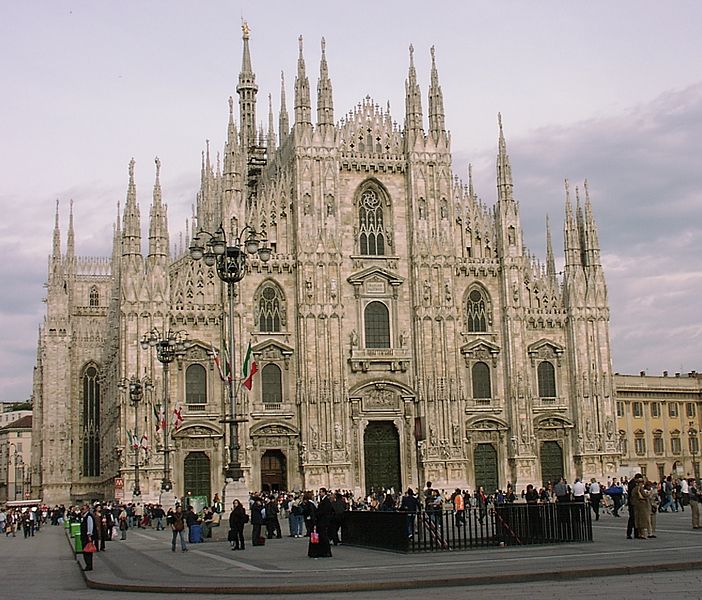
Possibly the most obvious piece of evidence is the total exterior form of the buildings. During the Romanesque times, as seen if you look at St. Gertrude Collegiate in Belgium (figure 5) the buildings don't look as elegant as the ones during the Gothic times, like the front of the Milan cathedral in France. (figure 6) This is because the buildings in Romanesque times were made to look more like protecting fortresses, and the Gothic structures looked more like castles. This was a way of displaying grace and beauty in the religious life, while the Romans were, again, focused more on protection (the purpose of a fortress) and preparation, for when the Lord comes to judge them again. As someone even comes to approach the building, they would know weather the focus of this group of people was protection or beautification.
The Gothic and Romanesque periods were two completely different times in many aspects, architecture being one of the most obvious. Through their designs and alterations, you can see the values of people displayed in those buildings. From the thickness of the walls and windows to the pictures on the front entrance, meaning and belief are displayed everywhere in these structures.
 |
| Figure 1 |
 |
| Figure 2 |
 |
| Figure 3 |
 |
| Figure 4 |
 |
| Figure 5 |
 |
| Figure 6 |
Links:


.jpg/450px-Nivelles_JPG00_(13).jpg)

.jpg/800px-Nivelles_JPG00_(6).jpg)

.jpg)

.jpg)


ELEVEN-POINT CRITIQUE
ReplyDelete1. YES (:
2 BEAUTIFUL
3. edit your fantastic citations
4. Yes
5. Good, but could be stronger
6. yes
7. Don't see any :p
8. Well done
9. Yes
10. Yes
11. Always
I really need your final draft for this essay! Email it to me. Thanks.
ReplyDelete